





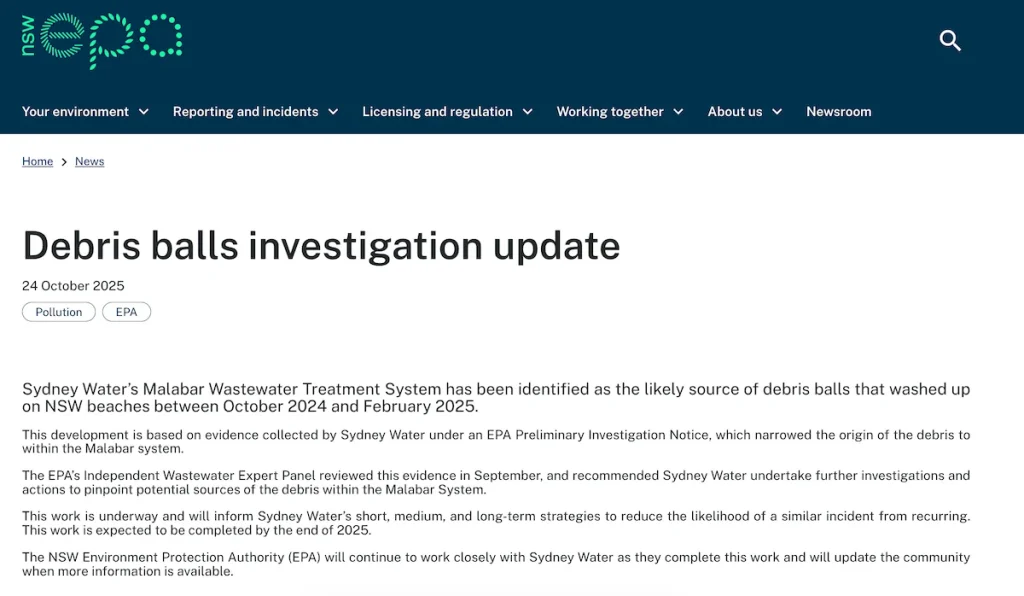
Residents across Sydney’s eastern beaches are learning that the murky balls of waste that washed ashore last summer likely came from the Malabar wastewater system, after environmental experts traced the source of the pollution to fats, oils and grease built up deep within the city’s sewer network.
The findings stem from a partly redacted report commissioned by Sydney Water and obtained under freedom of information laws by the media. The report, backed by an investigation from the NSW Environment Protection Authority (EPA), concludes that Malabar’s deepwater ocean outfall — a major part of Sydney’s sewage network — was the most likely source of the greasy debris that closed beaches between October 2024 and February 2025.
The EPA confirmed that tests matched the debris with human-generated waste, including fats and faecal material, and said further investigations are under way to locate the exact build-up within the Malabar system.
Experts trace pollution to Malabar outfall
Experts including Professor Stuart Khan, a wastewater engineer from the University of Sydney and chair of the EPA’s advisory panel, explained that the sewer feeding into Malabar had decades of accumulated fats, oils and grease that had adhered to the inner walls of pipes. These materials, combined with heavy rainfall, dislodge and flush waste deposits through the outfall tunnel, releasing them into the ocean.
According to Khan, the composition of the debris also matched industrial hydrocarbons consistent with wastewater from western Sydney, which is serviced by the Malabar catchment. He noted that the city’s growing population and rising number of food outlets without proper grease traps have intensified the problem, allowing more fats to enter the system and form blockages.
Rainfall and fats create a perfect storm
Environmental modelling by consultant firm WQ Data, commissioned by Sydney Water, showed how these fats and particulates could accumulate and then be swept into the sea following storms. Once expelled, the waste was rolled by waves into the black balls seen on beaches from Coogee to the state’s south coast.
The EPA’s findings indicate that while the Bondi and North Head treatment plants were also considered, Malabar’s heavier industrial inflows made it the most probable source.
Investigations and cleanup efforts continue
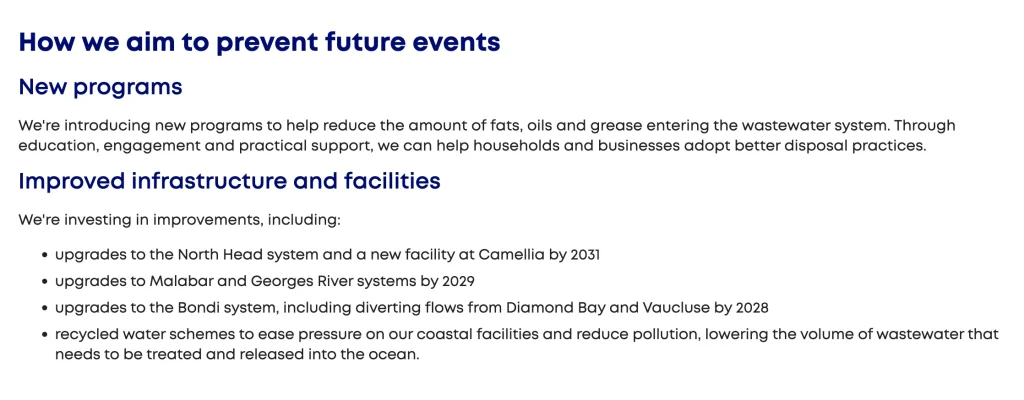
Sydney Water and the EPA are now working to prevent future events by strengthening trade waste controls, enforcing grease-trap maintenance, and exploring infrastructure upgrades. The agency is developing programs to reduce fats, oils and grease entering the wastewater system.
Planned upgrades to the Malabar and Georges River facilities are due by 2029, with further improvements at North Head and Bondi expected by 2031. The utility is also advancing recycled water initiatives to reduce the overall volume of sewage discharged into the ocean.
Community concern remains high in beachside suburbs such as Maroubra and Coogee, where residents recall last summer’s clean-up efforts.
Published 27-Oct-2025